


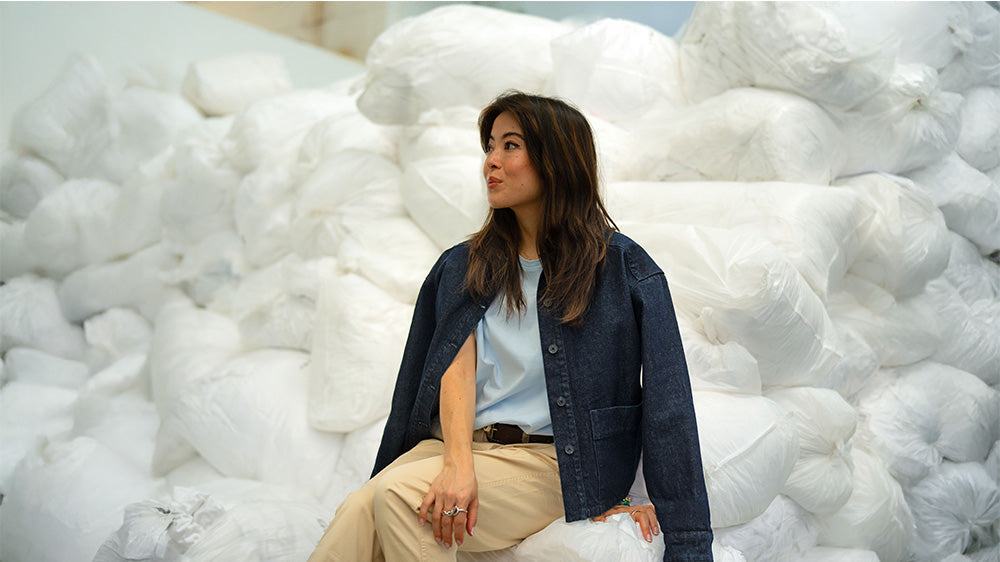
Many know her as the "Fabric Girl" or as the face of Säntis Textiles. We know her as one of the driving forces behind an innovation that has the potential to make the textile industry more sustainable: RCO100™, a material made from 100% recycled cotton.
Together with Annabelle and Säntis Textiles, we are working to advance the circular economy in fashion and rethink sustainable clothing.
Sustainable clothing needs new approaches
The fashion industry faces major challenges. Millions of tons of textiles are produced, worn, and discarded worldwide every year. At the same time, there is increasing pressure on companies to use resources more efficiently, reduce waste, and create more transparent supply chains. For Annabelle, this reality is nothing new: “If you grow up near textile production, you quickly realize that sustainability is not a campaign, but a challenge to existing systems.”
As the CEO of Säntis Textiles, she experiences daily how complex the textile industry can be. A wide range of interests must be brought together between textile collectors, producers, brands, and supply chains.
“I have experienced first-hand how complex this industry is. That's why I'm convinced that real change comes through patience, collaboration and better systems, not through quick fixes”, says Annabelle. Sustainability rarely arises from individual measures. Instead, it requires innovations that work in practice and can be implemented along the entire value chain.
Innovation in the textile industry from Switzerland
This is exactly where Säntis Textiles comes in. The Swiss family business has been working for years to develop new ways to recycle textiles. Developed by her father Stefan Hutter, a technology was created that can recycle cotton particularly gently: RCO100™. Unlike many conventional recycling processes, the fibers remain longer in this process. This means that old textiles and scraps from the manufacturing process can be turned into high-quality fabric again, without having to use new cotton. Annabelle has been accompanied and shaped by this process throughout her life: “Early contact with this technology gave me something that is still important to me today: responsibility. The responsibility to continue asking critical questions and to translate good ideas into real impact.”
The technology is still rare worldwide today. Currently, there are only a few facilities that enable this type of fiber processing. The potential for the future is all the greater. Because innovations like RCO100™ show that high-quality clothing and the circular economy do not have to be a contradiction.

Recycled cotton reimagined
For a long time, recycled materials were considered a compromise. Often, quality, comfort, or durability had to be sacrificed for the sake of sustainability. But this perception is increasingly changing: “For a long time, recycled materials were associated with compromises in quality. I believe the future shows us the opposite: quality and circularity can go hand in hand.”
This is exactly what makes recycled cotton so exciting. Instead of constantly using new resources, existing materials can be reused. This keeps valuable raw materials in circulation longer. For Annabelle, this change begins with a change in perspective. She is convinced: “Waste is often nothing more than material in the wrong place. Circular economy begins when we no longer see discarded textiles as an endpoint, but as the beginning of something new.” What is discarded today as old clothing can be the basis for a new garment tomorrow.
How we make sustainability visible
For our joint campaign with Säntis Textiles, we accompanied Annabelle to a place that perfectly reflects this idea: a Tell-Tex hall full of old clothing bags. Not only Annabelle looks small among the mountains of collected textiles. At the same time, the potential in already existing materials becomes visible. What at first glance looks like waste can actually be the beginning of a new cycle.
Exactly there begins the symbolic story of our joint products made from RCO100™. From 100% recycled cotton, the ReCotton Denim Jacket, Pocket Shirts, Chinos and Cargo Shorts – garments that show how innovation and sustainability can come together in the textile industry.
Why partnerships are crucial
New technologies alone are not enough to change the fashion industry. For innovations to have an impact, they must be implemented jointly by manufacturers, suppliers, and brands. Annabelle also sees collaboration as one of the most important factors for progress: “Innovation is important. But what we make of it is even more important. How do we manage to implement ideas in such a way that brands can actually use them?”
That's why NIKIN and Säntis Textiles share much more than just a material partnership. Both companies aim to make better use of existing resources and gradually implement a circular economy.
"The circular economy is created through cooperation. No single company can achieve this change alone," Annabelle is convinced. "The collaboration with Säntis Textiles is an important building block for us on the path to a more circular future."

The future of sustainable fashion
The demand for sustainable clothing is growing. At the same time, the demands on materials, transparency, and resource efficiency are increasing. Innovations like RCO100™ show that the future of the textile industry does not necessarily lie in new raw materials. Often, the greatest potential lies in the materials that already exist today.
When high-quality fabrics can be created from old clothes again, the circular economy becomes a real possibility rather than just a vision. And that's exactly why people like Annabelle Hutter are so important: because they don't just develop new ideas, but work to turn them into reality.
Because the future of sustainable clothing begins where we rethink existing resources. It starts with innovation, with collaboration, and with the conviction that something valuable can emerge from something old.


