


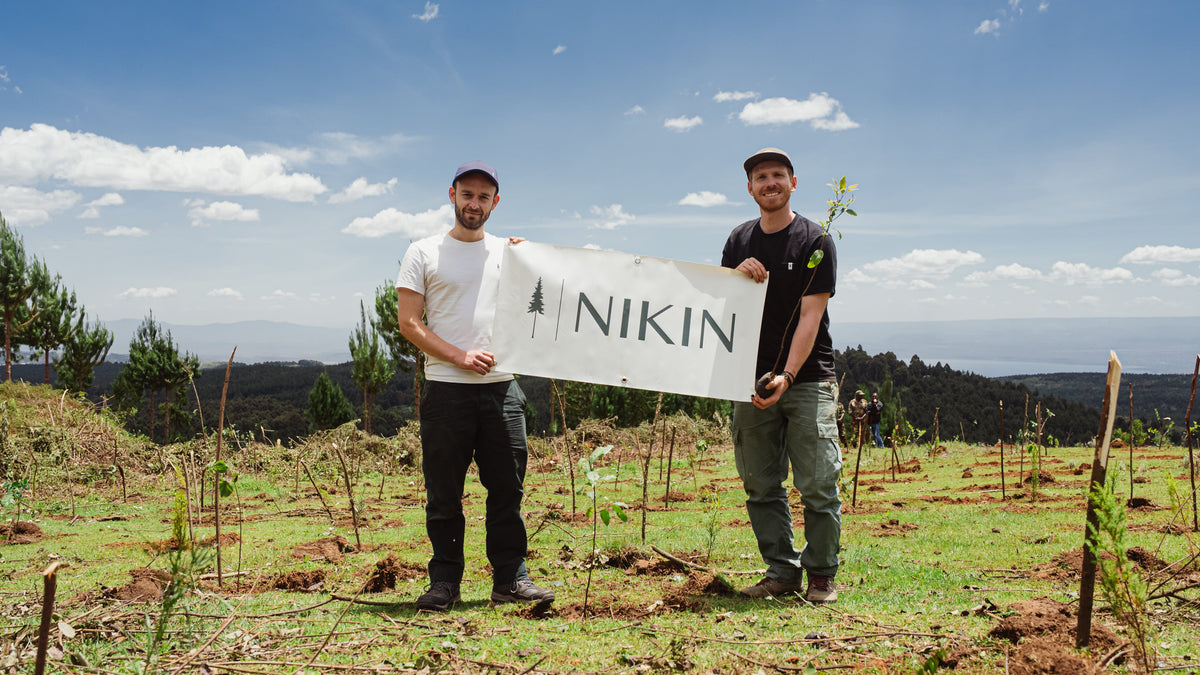
For our tenth anniversary, we, Nicholas and Robin, traveled to Kenya and Uganda. It was one of the most emotional journeys we have experienced to date. Standing in front of the very first trees we ever had planted with NIKIN was a special moment. What began back then with an idea and small saplings had visibly grown.
We wanted to get to know our tree-planting projects better and understand the long-term impact they have. In doing so, we met people who are dedicated to the forests with a great deal of knowledge and passion. At the same time, the trip took us to places that gave us food for thought as a clothing brand. We returned grateful and moved, with new questions and important impulses for the future.

Our very first trees ten years later
In Kenya, we visited the first reforestation project by One Tree Planted in the country. This is also where the very first trees we ever had planted with NIKIN are growing. Many are now five to seven meters tall, some even higher. A whole forest has been created. Seeing these trees with our own eyes made the past ten years tangible for us in a very special way!
The meeting with Miri was especially beautiful. She had already worked on the plantings about ten years ago and told us what the area looked like back then. We could feel how proud she is of the countless trees she planted herself, and how much this work means to her. Standing with her among these trees moved us deeply. Small saplings had turned into a whole forest.
Forest Rangers and local organizations are still working to protect the area today. Their work is important because illegal logging and grazing animals can endanger the development of a forest. People who were involved in the planting themselves also help look after its preservation.

Planting new trees together
We also visited the project currently supported by NIKIN in the Dundori Forest. A total of 150,000 trees are to be planted here, 40,000 of which we are financing. At the time of our visit, 29,000 trees had already been planted as part of the project. The forests in this region are important water reservoirs for large parts of the country.
On the planting day, a total of 5,000 saplings were put into the ground, about 20 of them by us. Irene from the Wezesha organization showed us what matters: carefully removing the sapling from its bag, planting it correctly, and leaving a small hollow where rainwater can collect. A stick helps to find the young tree later in the grass. Various native tree species were planted. The local planting teams were significantly faster than us and worked their way across the slope with impressive practice. Getting involved ourselves made us appreciate the work behind every single planted tree even more.

An additional highlight was the visit from Kenyan television, which reported on the project and our involvement. We were pleased that the joint work also received attention locally.
We were also able to get to know the work before and after the planting. In a tree nursery, we helped prepare saplings. The team from Wezesha explained how they work with the local population, integrate trees into agricultural land, and pass on knowledge. During school visits, we saw children planting and caring for their own trees.
These encounters showed us how much collaboration goes into a reforestation project. A young forest needs people who know it, use it, and want to protect it.

A look at future tree sites
Together with representatives from the Kenya Forest Service and the local Community Forest Association, we also visited an area that is to be reforested in the future. Having previously stood among the mature trees, we viewed this landscape with different eyes. We could now better imagine what might develop here over the years.
In doing so, we learned about the concept of "social fencing": if local people benefit from the forest and feel responsible for it, they help maintain it in the long term. This protection by the community plays an enormously important role alongside the actual planting.
John from One Tree Planted also explained how the progress of the projects is monitored. The partner organizations provide reports every six months. On sample plots of, for example, ten by ten meters, the number of surviving trees is recorded. From this, the survival rate for the entire area is estimated. Depending on the project, this is supplemented by recording individual trees with geographical coordinates and evaluating satellite imagery. After all, the crucial question is what is still growing years after a planting.
Dandora moved us deeply
 In Nairobi, we visited the Dandora landfill. Despite everything we had heard about it beforehand, we were hardly prepared for its scale. Amidst mountains of trash, smoke, and dust, people search for materials they can resell. Clothing is also among these items. What is waste for others is a livelihood for many people here.
Sam, who grew up in Dandora, led us through the area. With his organization, Dandora Green, he employs people, especially women, and collects textiles for reuse and processing. He explained to us that he also plants trees and has a small nursery at a school. The goal: to improve air quality in Dandora. His commitment in the midst of these difficult conditions impressed us greatly.

The visit made it clear how closely environmental issues and livelihoods are linked here. Many people earn their living from what others throw away. Changes must therefore also create prospects for them.
Among the waste, we saw shoes and pieces of clothing time and again. This sight affected us particularly deeply. What happens to products and clothes when we no longer want them? As a clothing brand, this question concerns us directly. In Dandora, it was more tangible to us than ever before.
Where clothing continues its journey at the Owino Market
At the Owino Market in Kampala, we experienced another stage in the life of used clothing. At the stalls, t-shirts, trousers, jackets, and shoes were piled high. In between, seamstresses repaired garments or altered them directly on the spot.
Together with Paula and Terence from BUZIGAHILL as well as our guide Miti, we explored the market. We discovered familiar brands, shirts from past events, and garments that had been discarded somewhere in the world. It was striking to see the paths that clothing travels and how many hands it passes through.

Here it became especially clear to us: just because we give clothes away for free to a charity collection, it is not simply given away at the destination. It is part of an international trade chain, is purchased, transported, sorted, and resold. At the Owino Market, people also have to pay for these clothes. Our clothing donation is a commodity there. Many people earn their livelihood with this trade and by keeping clothes usable for as long as possible.

How BUZIGAHILL creates something new from existing clothing
The team from BUZIGAHILL showed us how new fashion can emerge from discarded clothing. The brand, founded by Bobby Kolade, buys secondhand clothing in Uganda, reworks it, and sells the resulting pieces back to the Global North under the "Return to Sender" approach.
Paula explained to us how demanding the search for suitable starting pieces already is. Colors, materials, and quantities cannot be ordered at will on the secondhand market. Every design has to work with what is available.
In production, we were particularly impressed by a t-shirt that was put together from eight used shirts. A lot of work steps are involved: sorting, washing, dismantling, recombining, and sewing together. Seeing up close how much manual work and creativity goes into such a piece made us look at used clothing in a different way again.

We exchanged ideas about materials, longevity, circularity, and many other issues that occupy us as clothing brands. The visit gave us plenty of food for further thought. We are particularly concerned with how we can consider what becomes of a garment later, right from the design stage.

What remains and who we would like to thank
It is, above all, the people and the shared moments that remain with us from this trip. Miri, who talked about her planted trees with pride. The teams with whom we put saplings into the ground. Sam, who openly showed us his work and his everyday life. And the people at BUZIGAHILL, who opened up new perspectives for us with their creativity.
We have seen what can develop over the years when people work together on something. At the same time, we have taken home questions for which there are no simple answers. Both will continue to accompany us at NIKIN.
A special thank you goes to John from One Tree Planted. He accompanied us through the days in Kenya, explained connections, and took the time for our many questions. Thanks to him, we were also able to dive deeper into the local culture and the everyday life of the people. Through shared meals, personal conversations, and all the experiences, a partner became a true friend. We are very grateful for this.
Thank you also to the Wezesha Foundation and its founder Dr. Redempta Mutisya, the local project teams and communities, Sam and Dandora Green, as well as Bobby Kolade and the entire team at BUZIGAHILL. Thank you for sharing your time, your knowledge, and your stories with us.
And thank you to our NIKIN community, which has been supporting our tree-planting projects for ten years. Without you, we would not have been able to experience this moment: standing in front of our very first trees and seeing how a forest has grown from them. We are taking this feeling home with us.


