


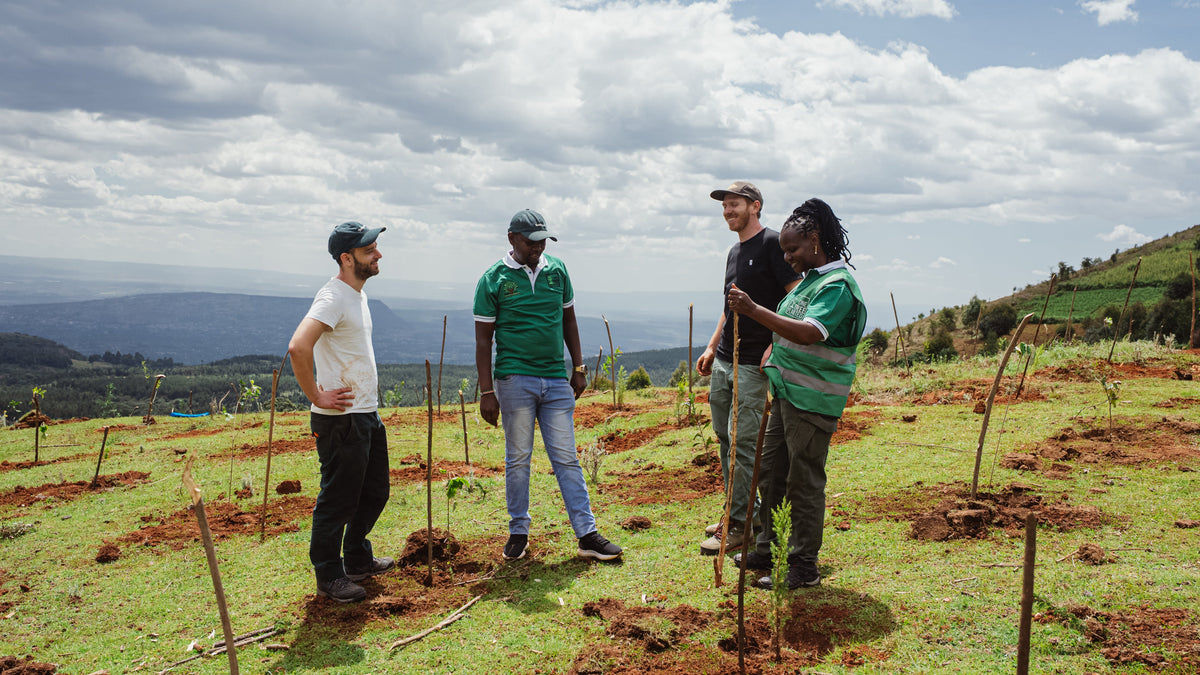
At the end of September 2026, Nicholas and Robin were in Kenya. For us, it was probably the most beautiful and emotional trip we’ve ever taken with NIKIN. One of our goals was to see our current tree-planting project with our own eyes and get involved ourselves. On one planting day, around 5'000 new trees were eventually planted. We planted about 20 of them ourselves, though the local teams were definitely faster than us.
40'000 Trees for Dundori Forest
A total of 150'000 trees are being planted as part of the project, and 29'000 are already in the ground. At NIKIN, we are funding 40'000 of the trees in the Dundori area. The region is essential to water supplies in East Africa.
Together with our long-standing partner One Tree Planted and local organisation Wezesha, NIKIN is supporting the restoration of degraded forest areas there. Many of these areas were cleared in the past, for example to create grazing and farmland or to collect firewood.
How tree seedlings are grown for reforestation in Kenya
Before planting day, we visited Wezesha’s tree nursery to understand the work involved in growing seedlings.
What we learned: The young trees are watered and cared for over several months before they can be planted out. We were able to help with the preparations and learned how important it is to choose tree species suited to each location.
It was lovely to see how happy the Wezesha team was to have us visit. We were welcomed with a dance, listened to speeches in Swahili and got to take seedlings out of the soil. This hospitality deeply moved us.

The people behind the planted trees
John from One Tree Planted accompanied us throughout the entire trip. He explained how suitable areas are selected, how collaboration with local organisations works and how the trees’ growth is monitored. We had lots of questions, and John took the time to answer every single one. We learned that educating the local population is a major part of reforestation: only when people understand how important trees and forests are will they be willing to protect them.
On the ground, Wezesha implements the project under the leadership of Dr Redempta Mutisia. She is a university professor and the founder of Wezesha. The organisation works closely with the local community, creates jobs and supports women and families in particular. Working at the tree nursery is also an important source of income for them. According to her, they have already grown 3 million tree seedlings in their own nursery.

Our planting day with 5'000 new trees
Together with the local planting teams, we drove from the tree nursery to the reforestation areas in Dundori Forest. As soon as we arrived, everyone was pitching in, laughing and helping one another. First, we transported the seedlings. Then Irene from Wezesha showed us what’s important when planting trees before we got to try it ourselves.

Monitoring, caring for and protecting young trees
Drought, animals, disease and human activity can all take a toll on young trees. John and our local partners showed us how they regularly monitor the areas. During visits and spot checks, they assess how many trees have survived and how well they are growing. If necessary—or if the survival rate is too low—trees are replanted and additional protective measures are taken.
Each project in Kenya also has forest rangers who protect the forest areas. They talk to the local population and ensure that illegal logging is kept to a minimum.

What schools and cooking stoves have to do with forests
We also visited schools with Wezesha. There, children learn why trees and forests are important, plant their own trees right next to the school and look after them with their teachers and Wezesha representatives.
Another part of the project is what are known as Clean Cooking Stoves, or more efficient cooking stoves. Many households cook over open wood fires, which use a lot of firewood and produce smoke that can harm people’s health. The more efficient stoves require less wood and produce less smoke. This eases the burden on families and reduces pressure on the surrounding forests. The Wezesha Foundation is committed to promoting these stoves as part of the project. We were reminded once again that this project is not just about planting trees, storing CO2 and restoring nature, but also about improving social conditions.
One final point worth mentioning: In the current project, the people who plant the trees are paid for their work. In addition, families from the region receive farmland for several years where they can grow their own vegetables. This creates not only new forests, but also additional income and food opportunities for the local population.

What we’ll remember from the tree-planting project in Kenya
When we think of Kenya, we picture Irene showing us how to plant, hear John’s explanations and remember dancing together at the tree nursery. We’re proud to support such a wonderful project with NIKIN. We’ve learned that a tree can accomplish more than you might think. In the project in Kenya, the trees are changing people’s lives not only today, but for many years to come. Ten years after founding NIKIN, this fills us with gratitude and gives us tremendous motivation to keep going and support this project, as well as other wonderful projects by One Tree Planted and our other partners.
So, thank you to John and One Tree Planted, to Dr. Redempta, Irene and the entire Wezesha team, to the Kenya Forest Service, the forest rangers and the local planting teams. Thank you for your time, your warmth and the work you do every day.
And thank you, dear NIKIN community. With every product you buy from us, you contribute to wonderful projects like this one and help make things a little better for both nature and the people who live there.
Nicholas & Robin, NIKIN co-founders


