


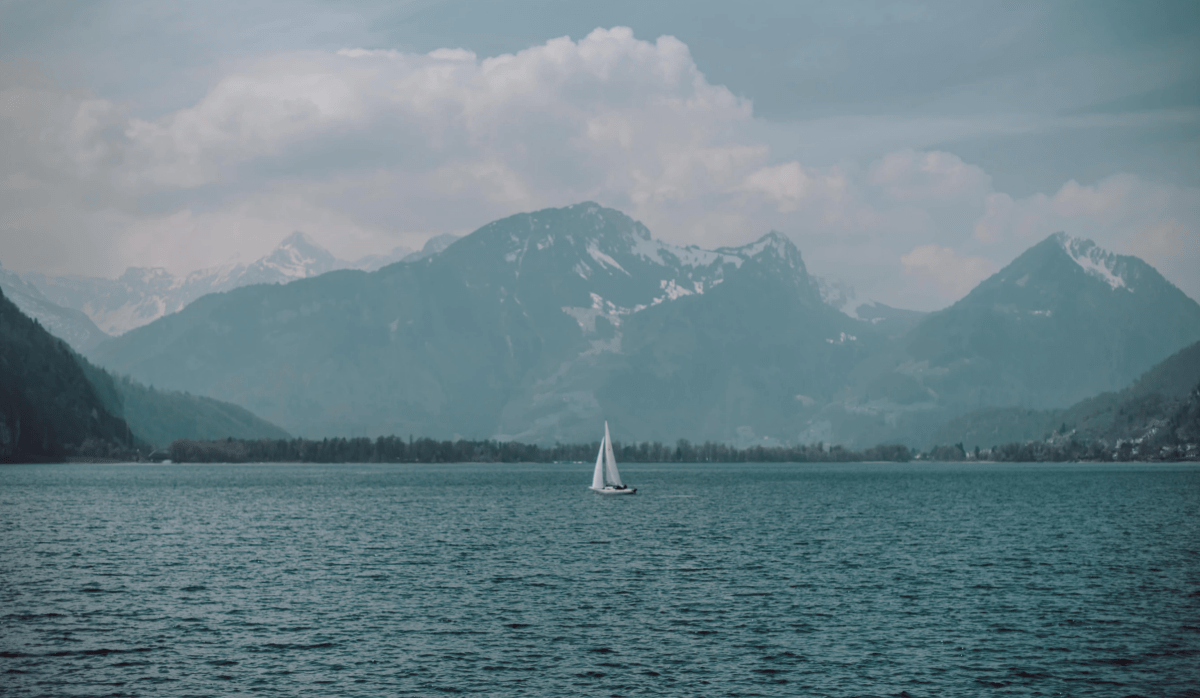
The last few weeks have demonstrated the power of water—especially when it overflows its banks. Switzerland is one of the most water-rich regions in the world and therefore boasts a multitude of beautiful lakes.

Switzerland – true to the country's image – is often associated with banks, chocolate, watches, and mountains. Yet the country's diverse streams, rivers, and lakes characterize the region just as much as the mountains, which are always within reach. On the southern edge of the Jura Mountains (running from northwest to northeast), the Aargau towns of Brugg, Windisch, Gebenstorf, Turgi, Stilli, and Untersiggenthal form a veritable triangle – here, the three largest Swiss Alpine rivers, the Limmat, Aare, and Reuss, converge. This region is therefore known as the "water tower of Switzerland." Hundreds of smaller and larger rivers meander through Switzerland's various regions, creating a multitude of lakes and a healthy water supply.

Swiss lakes and their origins
Most of Switzerland's lakes are of natural origin. They are often fed by meltwater from glaciers, which gives them their intense, blue-green color, which makes mountain lakes in particular appear like a piece of heaven in the middle of the landscape. Other lakes use existing basins that are filled and continuously fed by rivers. In Switzerland, these also ultimately get a lot of their water from glaciers – or from snowmelt. The largest lakes, such as Lake Geneva and Lake Zurich, have this kind of origin. For water quality, it is important that a river flows through the lake it feeds – where there is only an inflow but no outflow, the water gradually becomes salinized over the millennia.
Lakes create habitats
Lakes in Switzerland are not only important reservoirs of clear, high-quality freshwater. They regulate groundwater and surface water levels and provide specific biotopes for animals and plants in their surroundings. Aquatic plants, fish, waterfowl, and insects thrive in the lake itself, and mammals also find resting and hunting grounds in the reeds along the lakeshore. Transitional zones, also known as wetlands, form at the edges of lakes. This is where land and water meet, and with them amphibious creatures and plants. For all of them, a lake is more than just a source of water to quench their thirst—the entire life cycle of the creatures in and around the lake is oriented towards the water.

This is what makes lakes so important for nature and humanity – not to mention the fact that we humans find being near water soothing and calming. Therefore, many lakes in Switzerland are already protected, and worldwide, we would like to see even more bodies of water enjoy consistent protection. After all, water is a finite, precious, and essential resource for life on Earth.
The most famous lakes in Switzerland
Lake Zurich is probably familiar to every traveler to Switzerland – not only a landmark of the city, but also a local recreational oasis for Zurich residents, who enjoy its shores in both summer and winter for strolling, swimming, or sunbathing. Lake Geneva, shared by France and Switzerland, is equally famous. It is the largest body of inland water in both countries. Typical of Lake Geneva is its crescent-shaped silhouette and the panorama of its shores, which connects the Alps in the background with the vineyards in the foreground.
Lake Lucerne near Lucerne is also a popular travel destination, not just for Swiss people, as it boasts wild, romantic scenery with veritable fjords, something you won't find on Lake Geneva or Lake Zurich. The surrounding mountains drop steeply to the lake, and typical Swiss villages in five cantons invite you to linger along the shores.

Among the smaller lakes, there are indeed many glacial lakes, whose water remains breathtakingly cold year-round. However, the view from the first glimpse of Lake Blausee, Lake Caumasee, or Lac Lioson is at least as breathtaking. In fact, there are numerous hiking tours dedicated specifically to Switzerland's rivers and lakes.
Leisure at the lake in Switzerland
There's plenty to experience on and in the water. Tranquil mountain lakes, where you can camp on their shores, captivate the viewer. In summer, you can also swim in Switzerland's larger inland waters, and the entire range of nautical leisure activities is available near the city. These range from beach volleyball to pedal boats and stand-up paddleboards to sleek yachts anchored off Geneva and Zurich. Those who prefer a more leisurely pace can rent a rowboat to explore one of Switzerland's numerous lakes – or go kayaking on the country's wild streams.

Summer is not over yet – enjoy the remaining summer days at your favorite body of water with our swim collections !
Which is your favorite body of water and why? Let us know in the comments!


