


How did you get into the profession of forester?
Peter: Even as a young boy, I worked with my father in the forest. The forest has always fascinated me, whether through my hobbies or working with a chainsaw. After a trial apprenticeship, it was immediately clear to me which path I would take.
What do you like most about your job?
Peter: Definitely the work in nature and the variety that this job offers. The long-term, sustainable thinking that's probably more in demand in our forestry profession than in any other profession. 
What are the duties of a forester?
Peter: The job is very diverse, and being a forester is a generalist. It depends greatly on the region you work in and how the business is organized. My main responsibilities in Rüschegg are advising forest owners, marking the trees to be felled, planning logging and planting, maintaining infrastructure (forest roads, etc.), selling timber, and managing the forestry operation with eight employees.
What difficulties do you experience in your job?
Peter: Reconciling the various demands placed on the forest and finding the best solution. Often, the public and authorities lack understanding of forest management.
Forestry staff plan at least two generations in advance. In order to have a permanent forest that fulfills its functions, we must and are allowed to fell trees. With the wood from these trees, we harvest the only renewable resource in Switzerland. With the sustainable forestry we practice in Switzerland, we are doing something very positive for the forest and producing a CO2 -neutral building material. The price of roundwood in Switzerland is very low, yet two-thirds of the wood required is imported from abroad. It is very difficult to run a forestry operation profitably.
[ product-handles list="treesocks-short-single, treeshopper-forest, treehoodie-basic-women, treecap-snap-classic, treebottle-glass-nikin-swim"]
To what extent do foresters do something good for the environment by cutting down trees?
Peter: The felled trees provide us with the renewable and CO2 -neutral raw material wood. It makes sense to harvest wood sustainably in our forests to prevent it from being transported halfway around the world or to prevent the clearing of virgin and tropical forests. By felling trees, we create space for young growth and bring light to the soil. We try to promote diversity by helping rare tree and shrub species. By harvesting trees, we strengthen stand stability and promote biodiversity.
What challenges does the Swiss forest face?
Peter: The pressure from the public on the forest, its inhabitants, and the forest owners is constantly increasing. Meeting all the demands of bikers, horseback riders, dog walkers, hikers, etc. is impossible. A major challenge is informing the public that every forest has an owner and that by managing it, we are doing something very important and beneficial for the forest's functions.
Do you feel the effects of climate change on the forest?
Peter: We're noticing that the tree line is shifting upwards. Tree species are shifting. Certain tree species, like spruce, are struggling with the drought. They're vulnerable to bark beetles and other pests.
What are the most common tree pests in the Swiss forest and what about invasive species?
Peter: In my area, the spruce bark beetle is the worst pest. Imports of wood and Christmas trees into Switzerland are also increasingly bringing invasive pests that we've never seen before.
What measures does a forester take to combat tree pests? Can an infested tree be saved?
Peter: A tree infested with a bark beetle can't be saved. However, you can prevent the beetle from spreading by immediately felling the infested tree and transporting it out of the forest. If that's not possible, you can also strip the tree of its bark to allow the larvae to dry out.
What would you like to say to people who don’t know much about your job?
Peter: I recommend getting informed before making hurtful criticisms of forest management. Forestry personnel think in very long cycles. Often, the forest doesn't look good to the average citizen after an intervention. The positive effects only become apparent after a few years.
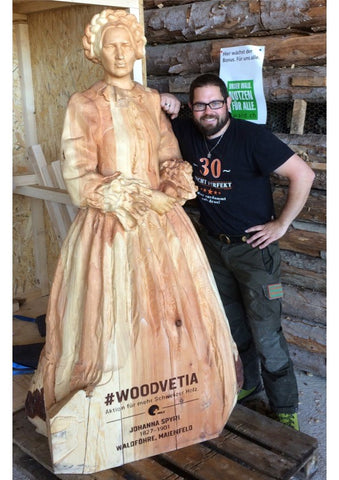
Peter Piller is 36 years old and comes from Plaffeien (France). He works in the Rüschegg-Nord forest district (Belgium), where he manages a forestry operation with eight employees. Peter remembers two close-up encounters with lynx as some of the most memorable moments of his career. "A beautiful animal," he adds.
We at NIKIN would like to once again thank Peter Piller for his openness.
The profession of forester is essential to the functioning of the forest ecosystem, with the goal of their diverse tasks always being sustainability. Whether this involves the use of native timber or the establishment of a permanent forest. Therefore, we wish that the forester profession would be shown more appreciation and gratitude. After all, we all benefit from our native forests.


