


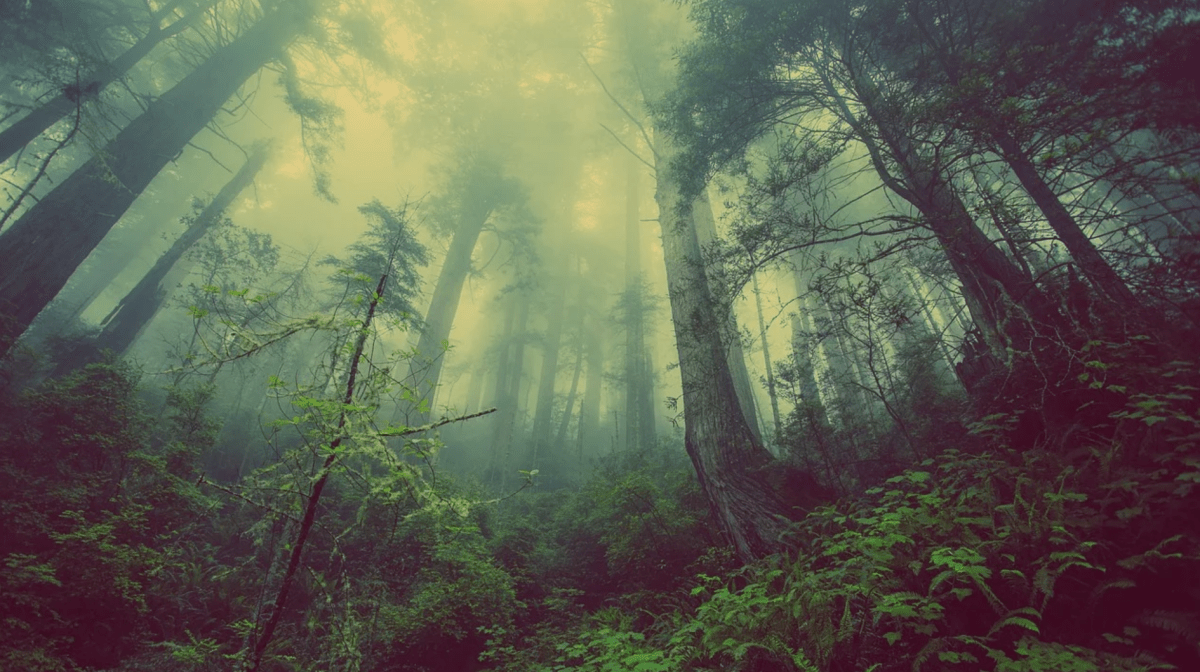
#10 Primorye Forest
The smallest of the ten giants is located in southeastern Russia. With its 130,000 km² , the Primorye Forest covers an area equivalent to 18.2 million football fields. It is home to many endangered species, such as the Siberian tiger. According to current estimates, its population is down to just 500 individuals. It is also the only forest in the world where tigers, bears, and leopards coexist.

#9 Burmese Tropical Rainforest
Myanmar, Asia, is home to one of the oldest rainforests in the world. Located between the Pacific and Indian Oceans, near the equator, it is rich in biodiversity due to the diverse environmental conditions it has experienced to this day. It provides a habitat for numerous exotic animal species, such as the Asian elephant, gibbons, and Bengal tigers.
Originally, this forest was part of a much larger environmental system, but due to increased deforestation and the industrial use of wood, its size is shrinking more and more. Today, it is (still) approximately 233,000 km² . If something doesn't change soon, the forest will likely disappear completely from the world map within our lifetime.
#8 Valdivian Rainforest
One of the youngest and largest forests in the world stretches across Chile and Argentina. Just 17,000 years ago, this landscape was still covered in perpetual ice. The animals living here are comparatively small. For example, the smallest species of deer, the pudu, and the smallest wild cat, the kodkod, live in this region. Unfortunately, even this forest is only partially protected and is therefore at risk from ongoing deforestation.
#7 Tropical rainforest on Borneo
The world's oldest tropical rainforest is located in Borneo, and has existed for approximately 140 million years. In addition to over 10,000 different plant species, it is also home to rare animal species such as the Sumatran rhinoceros, whose population is estimated at just 250 animals worldwide.
Borneo's most famous animal, the Bornean orangutan, is also on the endangered list, in the "critically endangered" column. This is largely due to the ever-increasing deforestation of the forest for industrial goods like palm oil. To ensure the preservation of this biodiversity, NIKIN, in collaboration with Borneo Orangutan Survival (BOS Switzerland), is planting trees here as well. Currently, the forest covers an area of approximately 290,000 km² , but if something doesn't change soon, the area will shrink faster than anyone would like.
[ product-handles list="treeshoe-slipon-unisex, basic-bicolor-unisex, treeleggings-women, treeshirt-pocket-women, treepack-hiking, treeshirt-longsleeve-raglan-unisex, treebottle-glass-allover-pines"]
#6 Tropical Rainforest of New Guinea
One of the world's most extraordinary rainforests is located in New Guinea. In addition to the diverse plants and animals, this forest is home to more than 1,000 indigenous peoples. Furthermore, a large portion of the forest remains unexplored, making it a hotspot for researchers from around the world. The fact that 5-10% of all animal species on Earth live here makes it all the more interesting for researchers, and it's no surprise that large parts of the 545,000 km² forest are protected.
#5 Tropical rainforest in the Congo
In contrast to the Valdivian rainforest, it is home to a variety of larger animals, including gorillas, hippopotamuses, and the African elephant, which is incidentally the largest land animal. As in the New Guinea rainforest, some indigenous tribes and peoples still live here in harmony with nature. Although it is currently one of the least affected by deforestation, its abundance of resources puts it at great risk. It currently covers approximately 1,780,000 km² , making it the second-largest rainforest in the world.

#4, #3, #2 The Taiga
The taiga once stretched from Canada through Norway to Siberia. Due to natural changes and continental drift, the forest split into three separate parts. Since they are essentially one and the same system, numbers 4, 3, and 2 are combined here.
The taiga is known for its enormous variety of fir trees, but due to its geographical location, biodiversity is limited. In winter, temperatures can drop to -40°C or lower.
But even in this essentially hostile environment, various animal species live, such as bears, wolves, foxes, and beavers. Despite its unilateral tree species, the taiga absorbs more CO2 from the atmosphere than tropical and temperate forests combined. Therefore, targeted protection of these forests is essential, but unfortunately, currently only very poorly guaranteed.
The largest part of the taiga is the Canadian Boreal Forest, covering approximately 4,200,000 km² . The East Siberian taiga covers an area of approximately 3,900,000 km² , and even the smallest part has an impressive area of over 2,156,000 km² . Overall, the taiga covers approximately 30% of the world's forests.
#1 Amazon
The undisputed number 1 is probably the most famous forest on earth, the South American Amazon. This forest of all forests not only has the largest area at an incredible 5,500,000 km² , but is also home to one in ten species existing on earth. It is the most diverse forest and has the greatest range of plants and animals in the world. In total, an estimated 290 trillion trees grow in the Amazon. Animals such as jaguars, spider monkeys, toucans, sloths and thousands of other species are among its inhabitants. It is an impressive 55 million years old, but due to human influence, the Amazon has already lost 20% of its original size. That's around 800,000 km² , the equivalent of the Primorye Forest, the Burmese Rainforest and the Valdivian Rainforest (numbers 10, 9 and 8) combined! An incredible 90% of this has been cleared for the cattle ranching industry.

Life without forests is impossible, and that's why it's up to us to do something to combat global deforestation. Even small steps can make a big difference. Donate a tree via OneTreePlanted , or lend a hand yourself and make the Earth a greener and therefore more beautiful place.
OneTreePlanted is a long-standing partner of NIKIN, with whom we enjoy a great working relationship. For every product sold, we plant a tree together with OneTreePlanted in a place in the world where it's urgently needed. So, if you order a Treeanie from us, for example, the planting of a tree is automatically initiated. With your order, we also send a personalized tree certificate confirming that a tree will be planted in your name.


