


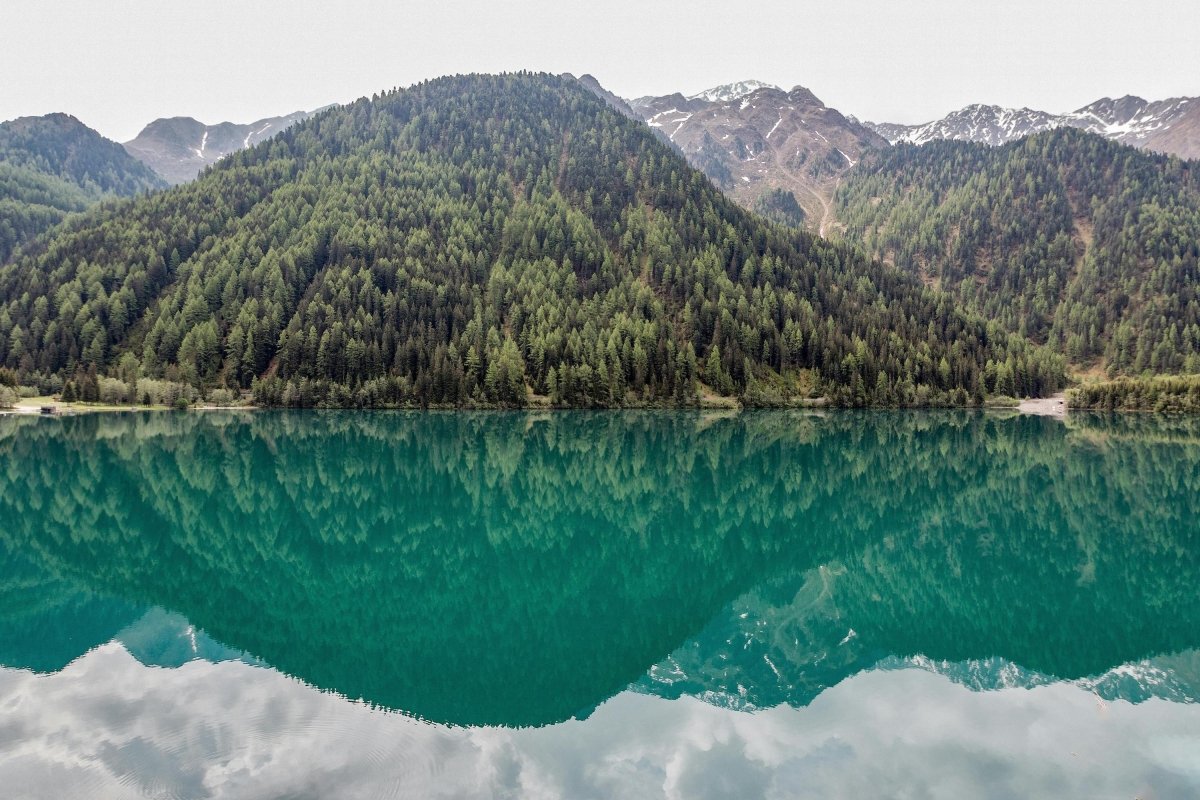

Image: The characteristic green of plants not only looks beautiful, but also converts CO2 into oxygen.
CO2 storage trees
Trees are known as the "lungs of the earth." Through photosynthesis, they filter CO2 from the air and release fresh oxygen back into the atmosphere – the carbon is stored in the process, which is why forests and rainforests are particularly important as carbon storage sites. When forests are cleared, this impacts their storage capacity, but the stored CO2 is naturally released when wood is burned. The "lifetime performance" of individual trees illustrates just how much this amounts to. An 80-year-old Douglas fir, for example, has stored an average of 3.7 tons of CO2 – as much as a round-trip flight from Zurich to Montreal (Canada)!

Image: The high plant density in the rainforest ensures a particularly strong CO2 storage effect.
CO2 storage sea
The ocean as a CO2 reservoir is just as important as the forest as a CO2 reservoir. The oceans and the plants living in them convert CO2 into oxygen through photosynthesis – just like 'ordinary' plants. The CO2 level in the ocean remained largely stable for millennia until the beginning of global industrialization, and the CO2-oxygen exchange between the oceans and the atmosphere was in equilibrium. Since industrialization, however, the oceans have increasingly become a kind of CO2 dumping ground – the oceans' absorption capacity is reaching its limits and the water is becoming acidic. In the long term, acidic water leads to the death of various marine organisms and plants and to coral bleaching. This also reduces the oceans' photosynthetic capacity, which in turn leads to even more acidic waters – a vicious cycle that must be broken.

Image: Coral reefs in the ocean store CO2 particularly efficiently – and are seriously threatened by the acidification of the world's oceans.
CO2 storage moor
The important role soils play in CO2 storage is less well known than the importance of forests and oceans. CO2 storage in soils includes the gas bound in deeper layers of the earth, but carbon dioxide is also virtually "locked" in peatlands and permafrost. The draining of peatlands and the warming of polar climates release this trapped CO2, destroying the absorption capacity of living peatlands and the plants they contain.

Image: Soils and peatlands also absorb CO2 – a fact that is often forgotten.
Protect system-critical CO2 storage facilities
Making life on Earth possible required a very long process in geological terms. Plants in particular, together with the absorption capacity of soils and oceans, ensured that the ammonia-carbon mixture of the early atmosphere changed very slowly. The result is the biodiversity of the "blue planet." The current high and still rising global CO2 emissions are shaking the foundations of the natural CO2 cycle – and the damage to important CO2 reservoirs such as forests, oceans, and soil exacerbates the consequences of this development exponentially. Therefore, it is more important than ever to raise awareness of these biological processes and to shape our own consumer behavior more mindfully.
NIKIN is committed to precisely this: on the one hand, we want to contribute to greater environmental awareness through informative blogs like these, and on the other, we want to offer an alternative to mass consumption through our products. For each of our products, we plant a tree, thus supporting the preservation of one of these most important CO2 sinks: the forest. Support us on this mission – together we'll keep the world green, #treebytree!


