


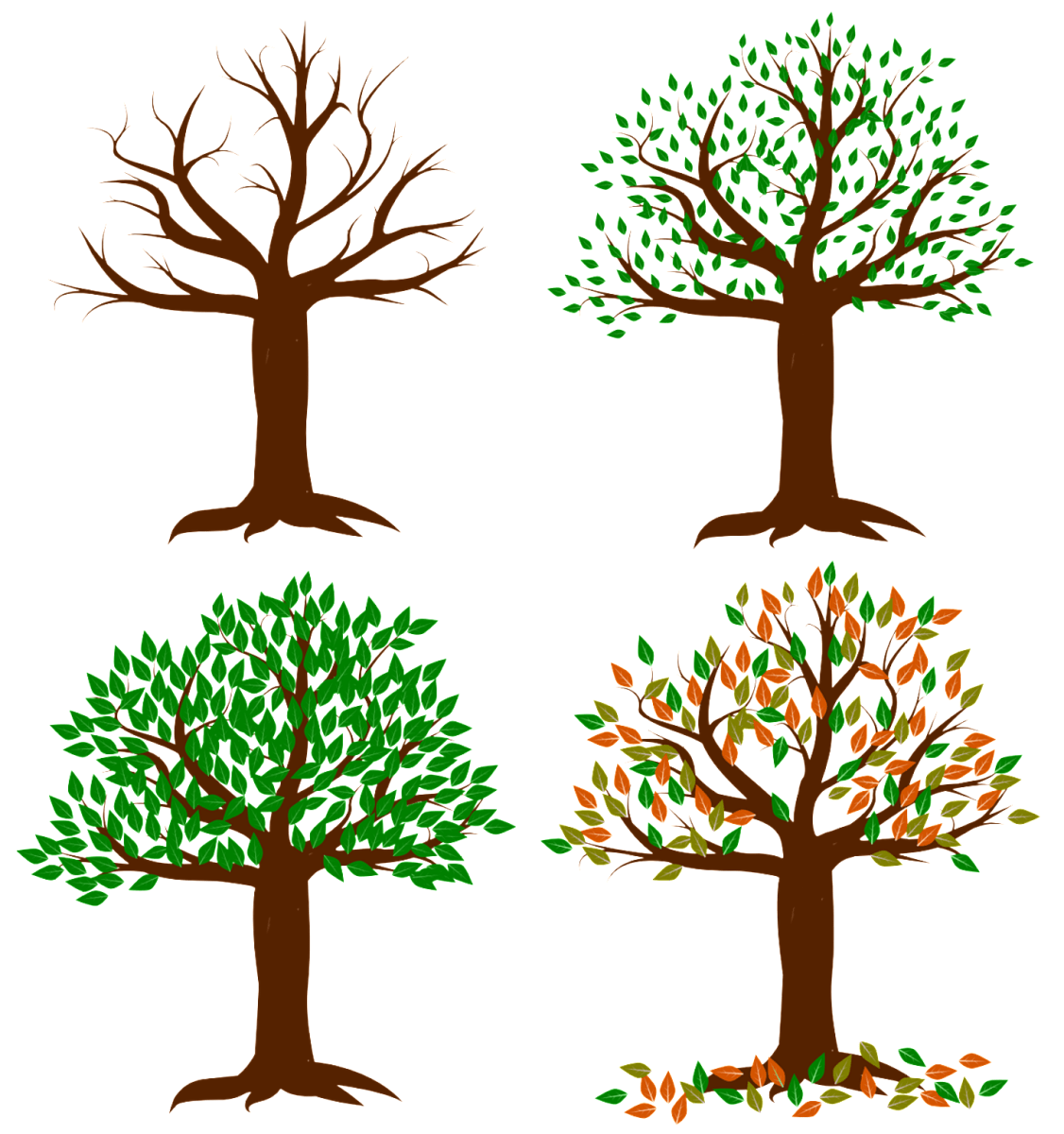
A refreshing swim in the summer, colorful walks in the forest in the fall, a warming fire in the fireplace under snow-covered roofs in the winter, and in the spring, nature awakens and the cycle begins anew – what could be more beautiful? Our seasons at a glance.
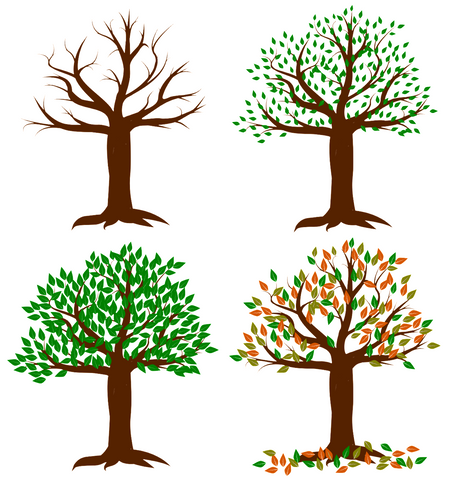
The seasons are familiar to us—we accept as completely "natural" that there are spring, summer, autumn, and winter. But are there really "only" four seasons? Or perhaps a few more? And what ensures that the seasons alternate so reliably—at least until now?
How do seasons arise?
To understand why weather and solar radiation change so noticeably throughout the year, one has to take a very broad approach—to a cosmic level, so to speak. Astronomical factors play a role in the creation of the seasons.
Sure, it's logical to assume that Earth's orbit around the sun has something to do with the seasons. Anyone who has ever seen a model of the solar system probably knows that all the planets orbit the sun not in circular, but in elliptical—or rather oval—orbits. So, does it get colder as the Earth moves further away from the sun?
No – not at all. The seasons arise due to the fact that the Earth's axis is tilted by approximately 23° from the vertical. With each rotation on its own axis relative to its orbit around the sun, the Earth "orbits." And this so-called precession of the Earth's axis is responsible for the seasons... because if the Earth's axis were at a right angle to its orbit, we would always have the same climate, worldwide.
Four seasons in change
As the Earth now spins slightly, it sometimes turns the northern and sometimes the southern hemisphere closer to the sun. This causes the seasons to differ. We are accustomed to using astronomical dates to determine the beginning of the seasons:
- Spring: It begins on March 21st, usually the date of the equinox, even when it still seems cool to cold. This is when nature gets ready and prepares plants and animals to resume their growth and reproduction cycles. All functions that were shut down during the winter are reactivated. This is helped by the increased incidence of sunlight, which not only awakens animals from hibernation but also makes us humans noticeably more alert.
- Summer: June 21st officially marks the start of the warm season and is also the longest day of the year. The flowers that opened in spring are now bearing fruit, which ripens thanks to the long, warm days. Baby animals born in spring grow up in the most favorable conditions imaginable in the summer. Humans are also significantly more productive in summer than in winter, because the longer exposure to sunlight is good for our health.
- Autumn: With the autumn equinox on September 23rd, long summer evenings in the garden are (usually) over – it's getting cooler, the days are rapidly shortening, and fog and rain dominate the climate. Nature is preparing for winter, but very slowly. Some plants are only now ripening their fruits, and in the animal world, courtship begins. Young animals are often weaned by this time, so their mothers are ready for another pregnancy.
- Winter: With the winter solstice, on December 21st, we record the shortest day of the year and the official beginning of winter—even though the days are slowly getting longer again. The cold and darkness seem hostile at first glance, but they are not. Winter is merely a necessary respite. Because soon, spring will arrive again...
Four seasons – really?
We in our latitudes are conscious of four seasons, but in reality, the year can be divided into many more and more differentiated phases. Phenology, founded by the naturalist Carl von Linné, distinguishes a total of ten seasons, because spring, summer, and autumn are further divided into early, main, and late phases.
The meteorological and astronomical beginnings of the seasons are also usually not identical. While astronomers base their seasons on the length of the day, meteorologists use the calendar months to divide the seasons. With such different perspectives, all we can do is hold our hands out the window to determine how warm or cold it is outside!
A consistently mild climate? It's possible!
Anyone looking to escape the seasons—and especially winter—can quickly identify places around the globe where little changes over the course of a year. Whether Uruguay, the Côte d'Azur, or Hawaii, they all lie in "temperate" latitudes. The closer you get to the equator, the less the seasons affect them. The length of the day also varies less. This is why the beaches of the Red Sea in Egypt or Madeira are such a great place to spend the winter. However, proximity to the equator doesn't always guarantee a pleasant climate, as some parts of the world experience seasonal monsoon rains. Not for the water-shy!
Conversely, those who want to experience the seasons in extremes can do so in Scandinavia. The higher the latitude, the longer it stays dark in winter. Whether you prefer to stay in Europe and enjoy the different seasons, or whether you're drawn to distant lands and the tropical sun, is, of course, a matter of personal preference.
The right outfit for every season
No matter how cold and wet the winter gets or how hot the summer, we at NIKIN want to help our customers find the right outfit for every weather, no matter the season. And ideally, we do this as sustainably as possible. One of our concerns is our commitment to preserving forests – all over the world. Forests play an enormously important role in our climate and the preservation of the planet. Therefore, we want our blogs to provide food for thought – including on interesting aspects of nature, in this case, the seasons.


