


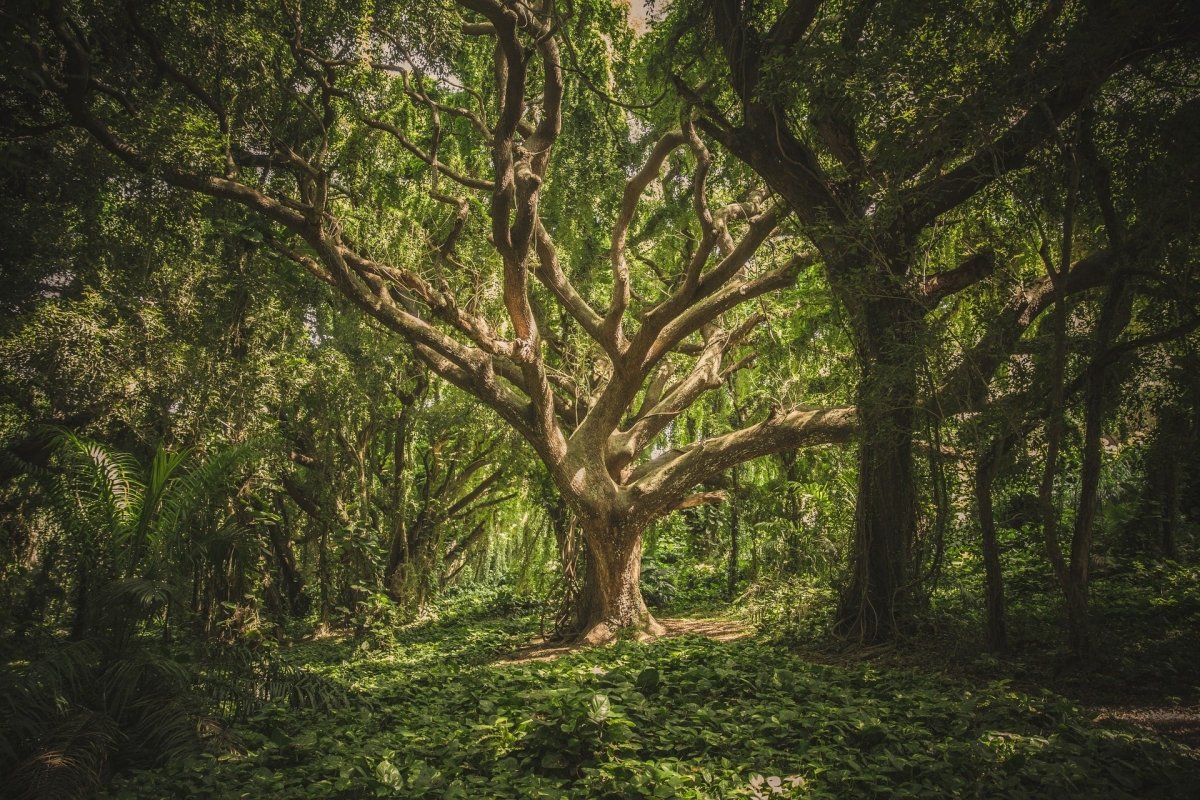
A living nature in which all plants are part of a greater whole, interacting, defending one another, perhaps even feeling fear or joy? This is not the Ent-Forest in Tolkien's Middle Earth, but any perfectly normal, relatively natural forest. Researchers like Peter Wohlleben have been drawing attention for years to the fact that plants do indeed communicate – only they do so very differently than animals or humans. The work of biologists, botanists, and so-called plant neurologists has proven that the WWW of trees, the Wood Wide Web, does indeed exist and is comparable to the Internet, also in terms of its complexity. Trees warn each other of dangers, engage in "brood care," and are even capable of communicating with animals.

The root brain of trees
Charles Darwin once compared plant roots, and especially their sensitive root tips, to the brains of lower organisms, and spoke of the powerful mobility of plants. Current research supports his point. Deep underground, roots collect information that is passed on to leaves higher up – for example, in the event of drought. The tree will "dormant" at least some of its foliage to cope with the water shortage. Conversely, the leaves signal the weather conditions higher up to the root system and, thanks to the process of photosynthesis, supply the roots with nutrients in the form of sugar.

How trees talk to each other
The perceptive ability of root tips was first demonstrated by Canadian forestry scientist Suzanne Simard and confirmed by Bonn-based cell biologist Frantisek Baluska. However, roots aren't content with simply holding monologues with their own canopy – trees also communicate with each other via their root network. They recognize when a conspecific is growing nearby, and both trees coordinate their growth to avoid interfering with each other. A tree also recognizes shoots from its own seeds and sends them nutrients. Besides its own roots, fungi primarily serve as intermediaries.

Exchange of information about the mycelium of forest mushrooms
The fungal bodies visible above the soil are only a small part of the fungus. The mycelium network, which can extend hundreds of meters, runs underground. The mycelium is the forest's information carrier; tree and fungus both benefit from the transmission of impulses. The tree supplies the fungi with sugar, while the fungus processes nutrients from the soil for the tree, which the plant would have difficulty accessing on its own. Scientists also owe Suzanne Simard the proof that and to what extent this nutrient transfer occurs – using radioactive carbon particles, the researcher was able to demonstrate the extent and the fact that even trees of other species benefit from it.

Managing predators – with plant poisons and attractants
It is now also known that plants not only "talk" to other plants, but also interact with animals – they react quickly and often surprisingly effectively, especially to herbivorous pests. The increased production of their own toxins can even prove fatal to large mammals if an otherwise "edible" tree feels unduly threatened. Plants also defend themselves against caterpillars. For example, oak trees send signals to neighboring trees when they are attacked by processionary moth caterpillars, and wild tobacco boosts its nicotine content. The tobacco plant can even attract beneficial insects such as lizards if the caterpillars cannot be controlled otherwise. As Ian Baldwin, Director of the Max Planck Institute for Chemical Ecology in Jena, discovered, the tobacco plant recognizes who it is dealing with from the saliva of the caterpillars.

Forests in documentary films – anything but extras
Documentaries vividly convey how well the forest's communication network functions – while simultaneously highlighting the damage caused by monocultures. A commercial forest is a monoculture that lacks the complex network of the Wood Wide Web. It lacks mutual protection and the supply of vital nutrients, as well as light and water, that trees, even those of different species, share with one another. Furthermore, they offer a glimpse into the forest's secrets from a perspective unfamiliar to us – that of the plants themselves.
We, too, are connected to trees! Find out when the next NIKIN TreePlantingDay is and learn more about our forest commitment .


