


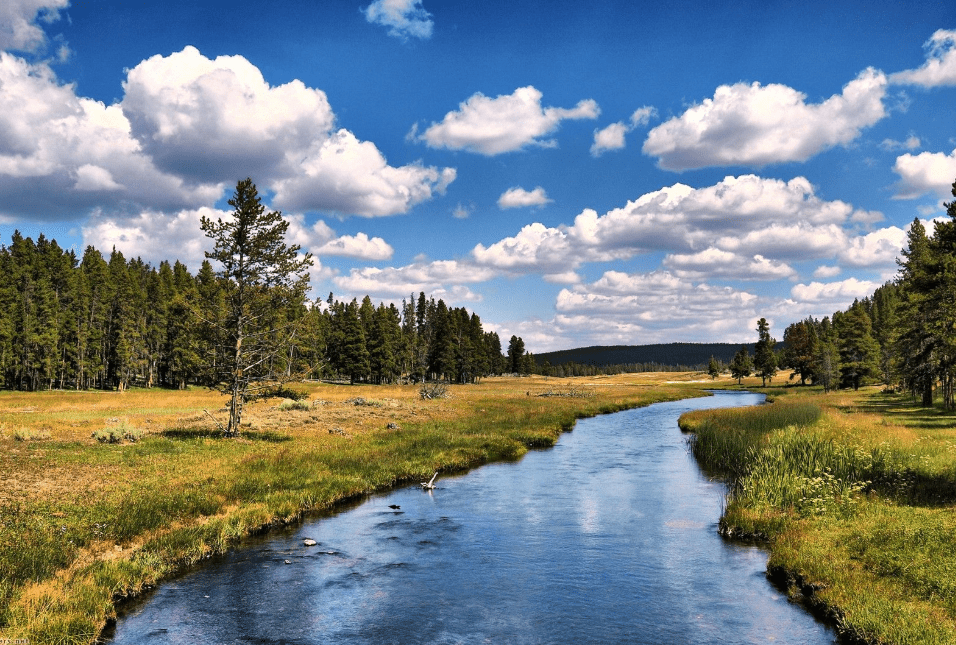
Where would we be without rivers? At least, we'd be pretty much stuck in the dry. The system of streams and rivers serves to distribute water across most continents. It provides the basis for life and food for numerous plant and animal species—and, incidentally, is also an important transportation route.

Where do the big rivers come from?
Rivers usually have humble origins. Streams originate in the high and low mountain ranges of the world, either from springs or fed by glacial ice and snow. Smaller watercourses flow downhill, where most of them converge. When the streams join, a smaller river is formed, which can grow into a broad stream where additional tributaries join. The river follows the natural gradient of the landscape and flows more or less in a straight line.
Unfortunately, most major rivers today have been straightened for navigation; in the past, they meandered leisurely in large loops through so-called floodplains. But whether winding or straight, at some point the river ends – when it flows into a larger body of water, such as a lake or the sea.
Life on the river: habitats for animals and plants
Along their journeys, the world's great rivers give, so to speak, "with both hands." The plants along their banks are home to small animals, birds, and insects; larger animals appreciate riverbanks as grazing grounds, and predators of all kinds hunt on and near the river. The fish population attracts birds that specialize in fishing, but also large predators such as bears and some cat species. Which animals and plants thrive along a river depends on whether you are in the headwaters, the course of the river, or the estuary. Along their entire length, rivers create an unbroken sequence of biotopes, each one unique.
Rivers also create networks that connect biotopes. They allow animal and plant species to spread and develop new forms of coexistence. Rivers shape the landscape in more ways than one.

Rivers of Switzerland
Switzerland also boasts a distinctive river system. While Swiss rivers can't compete with the world's longest six-thousanders, such as the Amazon, the Nile, or the Yangtze, Switzerland is the source of many famous European landmarks. The Rhone and Rhine, for example, originate here.
The Aargau “water castle”
Switzerland even has its own national "water castle" in the canton of Aargau. Here, in the area of Brugg, Windisch, Gebenstorf, Turgi, Stilli, and Untersiggenthal, the three Alpine rivers Aare, Reuss, and Limmat converge. From here, the Aare flows north until it empties into the Rhine near Koblenz. Around 40% of Switzerland's water volume converges here, and since 1989, it has been specially protected as an important floodplain by the "Water Castle Decree."
Outdoor sports and river activities
The activities on and along rivers are as diverse as the biotopes of the river landscapes. Rivers have traditionally been used not only for transportation but also by sports enthusiasts. Rowing, canoeing, and swimming are among the most popular recreational activities on clean rivers, while anglers, hikers, and birdwatchers appreciate the riverbanks.
There's nothing wrong with that in and of itself—however, nature lovers should make an effort not to disturb the animals or harm the flora. Rivers, as our common freshwater reservoirs, deserve our protection, as do the fauna and flora that live with, in, and from them.

Rivers are worth protecting – and everyone can contribute
It goes without saying that the pollution of rivers and river landscapes must be stopped. Unfortunately, it is still all too common for water bodies to be used as sewers – only a few major scandals reach the public. Those who take a closer look, consume more consciously, and adjust their own behavior a little can, among other things, contribute to protecting rivers.


