


Climate change is real, and devastating natural disasters are becoming more frequent. Entire forests are burning, animal species are becoming extinct – and there's another event that, although occurring very slowly, has serious consequences: the melting of glaciers.

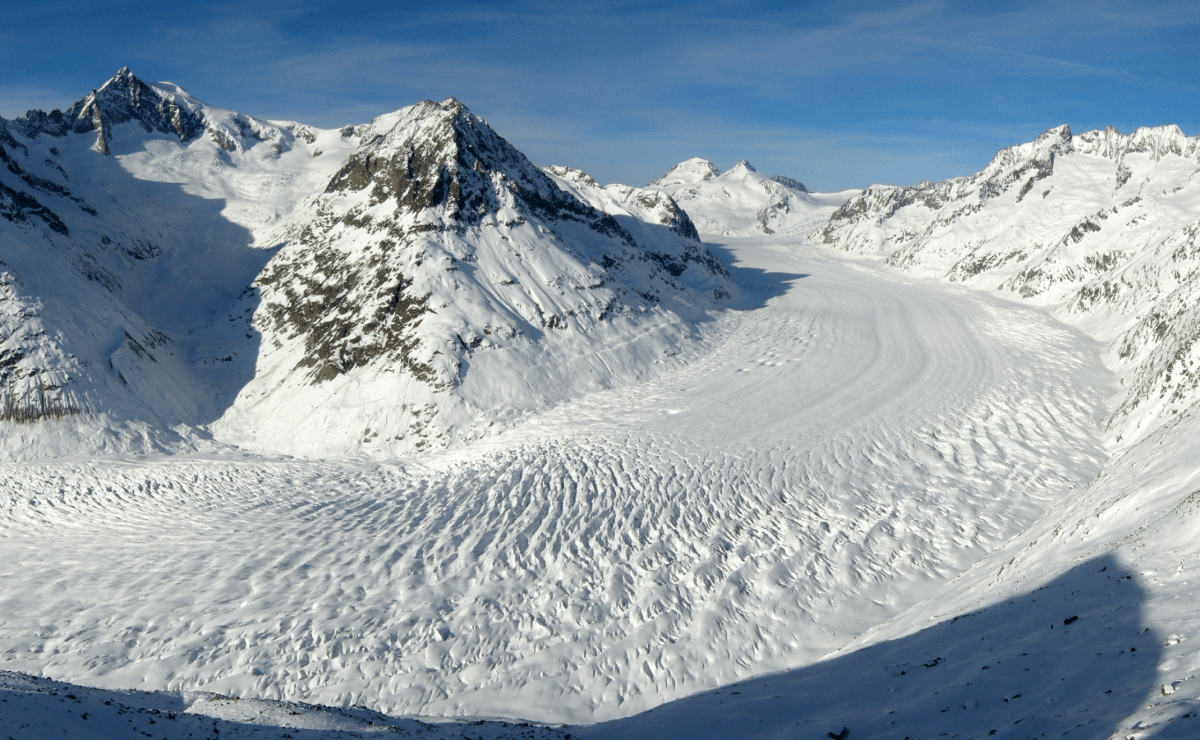
Aletsch Glacier, Switzerland
At NIKIN, we are particularly committed to protecting forests worldwide. But it's not just the forests that are disappearing; glaciers are too. Global warming is having disastrous consequences due to the water stored in the ice, which is being released at an ever-increasing rate and causing sea levels to rise. These consequences impact not only nature and the environment, but also us humans. We're up to our necks in water—and that's why it's imperative to stop this rapid glacier retreat.
What exactly are glaciers?
Glaciers are masses of ice formed from compressed snow. The incredible amounts of snow needed to create the largest glaciers are hard to imagine. For a glacier to form, several conditions must be met. The most important of these is that there must be sufficient snowfall every year for a very long time. The snow must fall in such large quantities that less melts than remains on the ground. This way, a little snow is added each year. When combined in large quantities, a lightweight snowflake becomes a ton-heavy burden. Gradually, the lower layers are compressed and turn into ice.
Always on the move
Since glaciers form far above the snow line, i.e., in mountainous regions, another element comes into play: movement. The heavy weight of ice doesn't stay where it is, but slides downhill. Only a few centimeters at a time, but noticeably. In doing so, the ice masses shape, grind, and scrape the landscape, carrying with them enormous boulders and other material that remains long after the glacier has ceased to exist. Traces of the last ice age can still be seen in Central Europe, which has now returned to warm temperatures.
Glaciers – they are the biggest!
Due to their compressed water masses, glaciers are the largest water reservoirs after the oceans – and thus have a significant impact on the global climate. The world's largest glaciers are:
- The world's largest glacier is the Lambert Glacier in East Antarctica
- Iceland's Vatnajökull is considered the largest glacier in Europe
- The Jostedalsbreen in Norway is considered the largest glacier on the European mainland
- the longest in Switzerland is the Aletsch Glacier
- The Malaspina Glacier in Alaska is the largest glacier outside the polar region
- In the tropical zone, the Peruvian Quelccaya is the largest glacier
- the Campo de Hielo Sur is the largest glacier in South America
- In Germany, the Schneeferner is number one
- In Austria, the Pasterzen Glacier is the largest
- In the Caucasus, home to high mountains, the Bezengi is the largest ice mass

Breiðamerkurjökull (Vatnajökull), Iceland
Swiss glaciers – acutely threatened!
Switzerland boasts a wealth of glaciers. They are part of our landscape, but are acutely threatened by climate change. The Aletsch Glacier is a UNESCO World Heritage Site, but the Rhone, Fee, and other glaciers are also iconic Swiss landmarks. Over the past two decades, these ice giants, which previously pushed their way down the valley inch by inch, have retreated – often by several kilometers. Climate protection in Switzerland also means, and above all, glacier protection. Almost 700 glaciers are said to have already disappeared – the phenomenon is so striking that environmental activists have even held funeral marches for "dead" glaciers.
Why are glaciers disappearing?
The ice masses are naturally suffering from rising temperatures worldwide. At least equally devastating is the lack of snowfall – because the glaciers are no longer "fed." The result is that more ice is melting than can be regenerated. The glaciers are, in a sense, receding. According to experts studying the future of Swiss glaciers, most of the smaller glaciers will have disappeared by 2050. Fifty years later, only fragments of the larger glaciers will remain. This will affect the water balance and the stability of the rock and soil layers in the mountains, as well as the fauna and flora.
Protect glaciers through climate protection!
To preserve the world's glaciers as a unique biotope, a global rethink is necessary. Years of debate won't help. Every single person bears a responsibility. And that means we must become more sustainable in our consumption habits and lifestyles. It won't work without sacrifice – but if we look beyond the boundaries of our own small community, we can preserve the wonders of our world for our children and grandchildren. We at NIKIN want to work towards this goal, too.


