


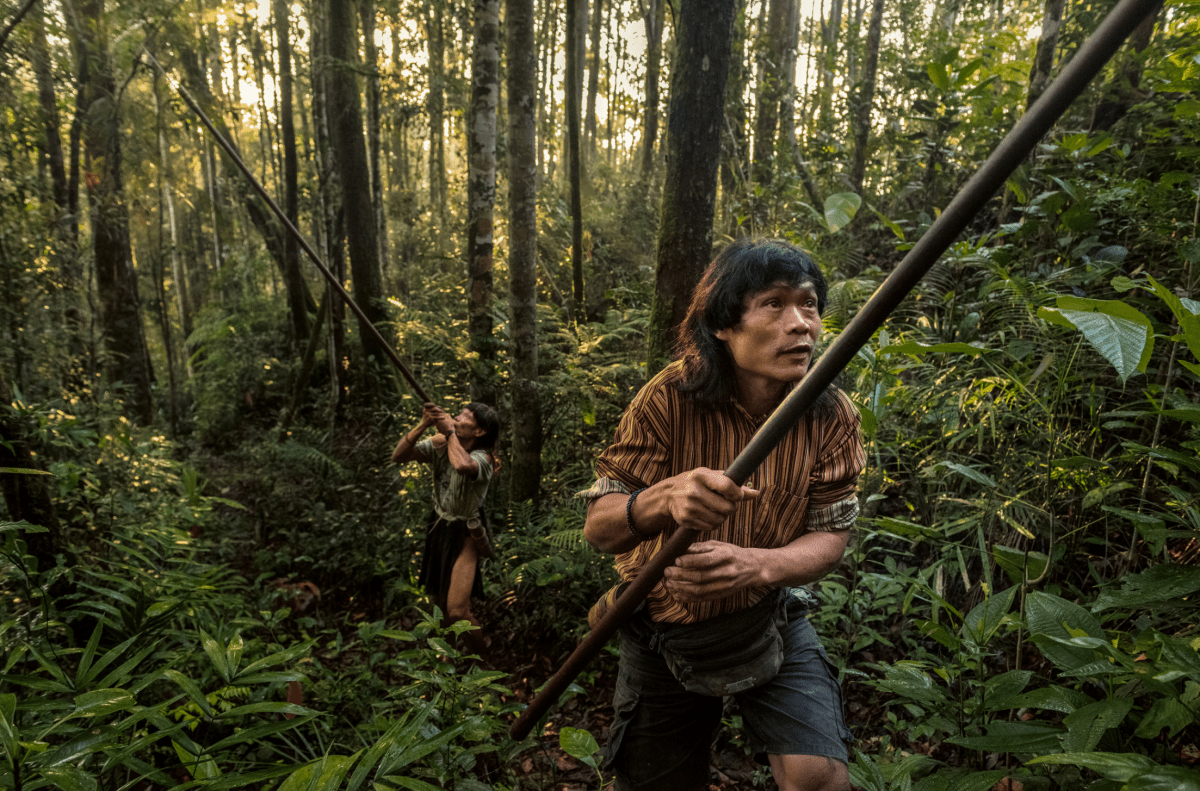
The rainforest of Sarawak on Borneo is home to and the livelihood of the Penan. Even twenty years after environmental activist Bruno Manser fought with the Penan against deforestation, the forest is under threat. Photographer Tomas Wüthrich's book, "Doomed Paradise," provides a striking insight into their life in the forest.
© Tomas Wüthrich
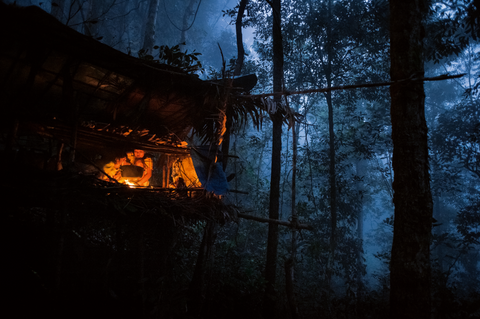
Since 2014, photographer Tomas Wüthrich has been documenting the daily life and culture of the Penan. Originally a nomadic people living in the jungles of Sarawak on Borneo, this people are threatened by illegal deforestation. The Penan first came to international attention in the 1980s through the Swiss environmental activist Bruno Manser. Manser dedicated himself passionately to the indigenous population and the rainforest for many years. He has been missing since May 2000 and was declared missing in 2005. In his book , "Doomed Paradise - The Last Penan in the Rainforest of Borneo," Tomas Wüthrich paints a nuanced picture of their lives today, shaped by their knowledge of nature and, increasingly, by modern technology.
Nomadic life in the forest
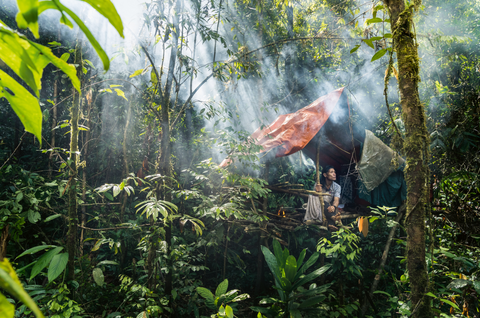
Well into the 20th century, the Penan lived a nomad lifestyle in the basin of the great Magoh and Limbang rivers, without farming or raising livestock – the forest and rivers provided them with everything they needed. Hunting babui , the wild bearded pig, and harvesting flour from the sago palm were – and still are – particularly important. In the 1950s, anthropologist Rodney Needham came to Sarawak and began researching their way of life and culture. Needham's findings form the basis for the work of Canadian linguist and documentary filmmaker Ian Mackenzie, who has been researching the Penan language since 1991, collecting their fascinating myths, and now publishing a selection in Penan, English, and German for the first time in Tomas Wüthrich's Doomed Paradise . Mackenzie learned about the Penan through Bruno Manser. The myths can also be heard via QR code.
© Tomas Wüthrich
Settledness and modernity
Most of the approximately 10,000 Penan eventually settled down under pressure from the government and Protestant missionaries and began to cultivate rice. However, the lifestyle of some Penan transitions seamlessly into nomadic life: One example is the semi-nomadic group led by Chief Peng Megut, who is the focus of Tomas Wüthrich's photographic work. The photographer spent around six months alone with Peng Megut's group, documenting their daily life, their blowgun hunting of bearded pigs and monkeys, and their harvesting of sago palm flour. He also documented the importance that cell phones, televisions, motorcycles, and cars have assumed. It is fascinating that Peng Megut and his group have succeeded in preserving a green island with largely intact rainforest in the middle of an area that has been repeatedly deforested.
Resistance to deforestation
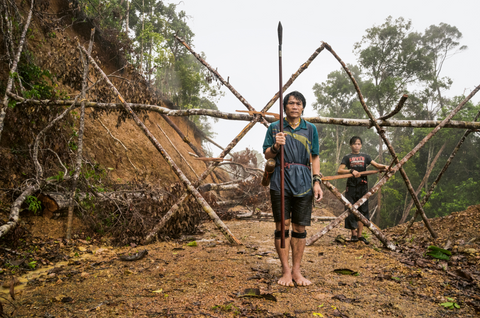
The logging companies invaded Penan territory in the mid-1980s. Blockades of logging roads were the most important form of civil and nonviolent resistance. However, by 2000, only about ten percent of the forest area remained untouched. Resistance was particularly difficult for the nomadic and small Penan groups in the Magoh, Limbang, and Meli'it regions. They continue to erect roadblocks and guard and defend their forest territory.
© Tomas Wüthrich
Rainforest conservation maps
During his lifetime, Bruno Manser founded the Bruno Manser Fund (BMF), which supports tropical rainforests, their wildlife, and their people, but especially the rainforest on Borneo and the way of life of the Penan. As part of a community mapping project, the BMF worked with the Penan to develop precise maps documenting their land rights. The importance of these maps became clear in October 2018, for example, when the police, called in by the Lee Ling timber company, unexpectedly ordered the loggers to respect Peng Megut's land rights and leave the area.
Fragile existence in the rainforest
Tomas Wüthrich's photographs demonstrate how the richness of the rainforest continues to support the Penan's life and culture, yet how fragile their existence has become. Tomas Wüthrich's book, "Doomed Paradise - The Last Penan in the Borneo Rainforest," calls on us to do more to protect the rainforest and preserve this ancient, natural way of life.
Printed on 100 percent tree-free paper made from lime flour and bound without toxic glues, the book brings not only the images but also, for the first time, the written myths back to their place of origin: to the Penan.
© Tomas Wüthrich
NIKIN – What we do for the rainforests
At NIKIN, we're committed to ensuring that the world's forests continue to provide the habitats the animals and plants need. That's why we support the work of our partner organization OneTreePlanted. With every purchase from NIKIN, you donate a tree! This way, with a small amount of money, you can help prevent the rainforest from disappearing completely.
The author: Tomas Wüthrich
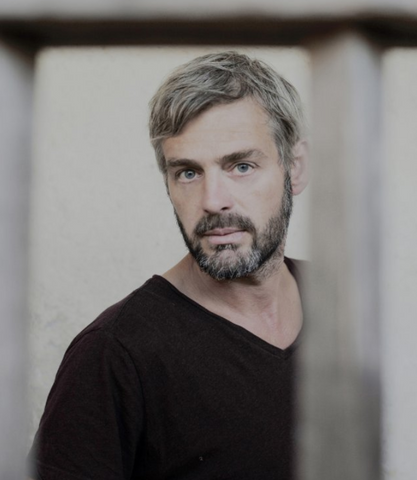
Tomas Wüthrich is a freelance Swiss photographer. His award-winning reportages and portraits have been published internationally, including in GEO, Das Magazin, and NZZ am Wochenende. Between 2014 and 2019, he accompanied a group of Penan, a largely nomadic tribe, during several extended stays on Borneo. He lives in Liebistorf, Switzerland.
© Andri Pol
- The book is available from Scheidegger & Spiess Verlag: Scheidegger & Spiess Verlag
- An exhibition takes place in the Kornhausforum Bern: Kornhausforum Bern
- Tomas Wüthrich's website: www.tomaswuethrich.ch


