


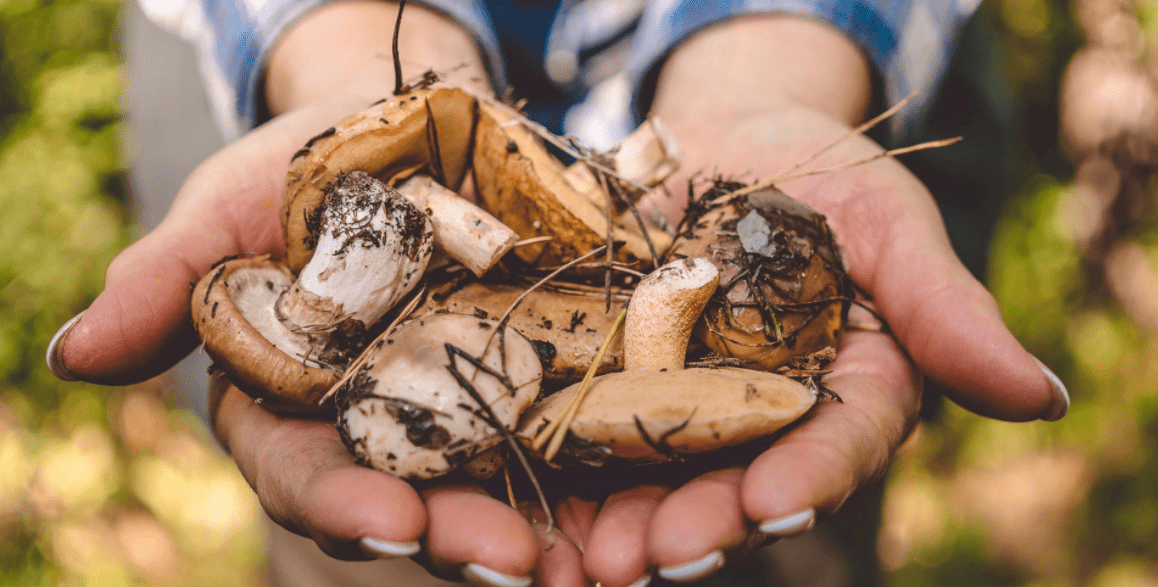
We're familiar with mushrooms, right? Most people, if asked, would probably say without hesitation that their edible mushrooms are a type of vegetable. Baker's yeast, however, is a bit more complicated, as it's also a fungi. But what are mushrooms, actually?
A kingdom of your own
The extremely versatile "fungi" are neither plants nor animals, but form a third group. Like plants, they are spatially dependent, but since they are unable to "feed" through photosynthesis, they enjoy organic substances. That's right, mushrooms "eat," if you will—with the help of enzymes.
These diverse organisms are more closely related to animals – and thus to us – than to plants, but they are still not sufficiently researched. Of the estimated 5 million fungal species, around 100,000 have been described in detail. Among the well-known fungi are basidiomycetes, including our edible mushrooms, but also single-celled organisms, of which baker's yeast is one.
The actual fungus lives underground
If we refer to what ends up on our plates as mushrooms, we're actually not quite right – because the so-called basidiomycetes are merely fruiting bodies. The fungus is the so-called mycelium, a network of fine threads in the soil. If conditions are right, the mycelium produces the above-ground umbrellas that we enjoy so much. For this to happen, a warm period must be followed by enough rainfall to ensure the fruiting body matures until the spores are released. Most fungi reproduce asexually, even if a species is already further along and has gametes.

Mycorrhiza: Symbiosis with fungi
In nature, the versatile inhabitants of the fungal kingdom have an extremely important function. They often live in symbiosis with other plants, especially trees. Both partners benefit from this coexistence. As a mycorrhiza, the fungus surrounds the plant roots with the threads of the mycelium, thereby increasing their surface area and helping the host plant absorb water and nutrients. The fungus also protects the tree underground from disease. Trees show their gratitude in return: they share the carbohydrates produced during photosynthesis with the fungus. Only in a few cases is the symbiosis limited to certain cooperating species – both the tree and the fungus can be very active, and the mycelium network often connects numerous trees underground. A social network, similar to social media.
For fungi, this means: If the forest suffers, this life form is also threatened. Fungi and trees are both saying goodbye to a stressed ecosystem. Only through a return to near-natural forest management and consistent climate and nature conservation can the biodiversity of forests be preserved.
Identify and collect mushrooms yourself
The fruiting bodies of mushrooms in the forest include numerous popular edible mushrooms – but also highly poisonous species. Those unfamiliar with the species can easily be mistaken for one. The bright red fly agaric is well known, but other species can also have serious consequences if eaten. Mushroom experts recommend that beginners start by collecting only boletes, as gilled mushrooms are easily confused – poisoning often results when a death cap is mistaken for a meadow mushroom. If in doubt, the nearest mushroom testing station is the best place to check for your loot.

If you don't want to pick your own mushrooms, you can find good quality edible mushrooms at the market. These include the delicate porcini mushrooms, the bright yellow chanterelles, and in the fall, the subterranean truffles, whose intense aroma transforms even plain pasta or scrambled eggs into a delicacy. Fresh mushrooms also offer a taste experience that far surpasses any canned product.
No matter which mushroom you choose, it should be fresh. Mushroom poisoning is most commonly caused by perfectly normal edible mushrooms that are simply too old and spoiled. The protein in the fruiting body decomposes faster than animal proteins, and what looks perfectly fine on the outside is already rotting on the inside. A fresh mushroom should be crisp and fragrant. Then you can eat it without worry.
Mushrooms are worth protecting!
Our commitment to the forest goes beyond simply planting trees! We want to encourage the protection of existing ecosystems through sustainable and environmentally friendly practices. Mushrooms, for example, are an essential part of a forest, both for aesthetic and functional reasons! Our behavior can preserve this natural wonder – through conscious consumption and environmentally conscious decision-making.


