


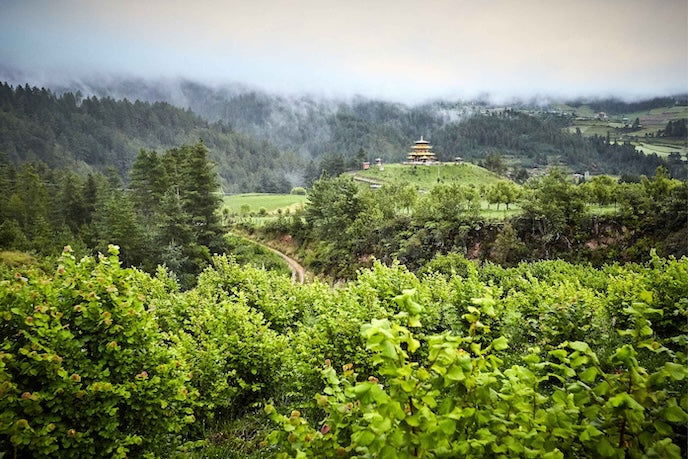
Why Happiness is More Important Than Growth in Bhutan
Bhutan is a land of contrasts: small yet rich in nature, poor in resources yet full of cultural treasures. Above all, however, Bhutan is one of the few countries in the world that defines not growth, but happiness, as the ultimate goal of its national development. How happy a country is can actually be measured, and Bhutan does this with the so-called Gross National Happiness Index. Internationally, the World Happiness Report is used, and in 2024, Switzerland ranked 9th. But even in the "happiest country in the world," climate change is already having a noticeable impact. Especially in rural areas, people suffer from changing weather conditions, uncertain harvests, and limited access to income. This is precisely where our current project comes in.

Planting Trees for People, Nature, and the Future
Together with our partner One Tree Planted, we are supporting a social impact enterprise in Bhutan in October and November that specializes in cultivating hazelnut trees. These are planted on fallow (areas that are not planted or cultivated) and degraded mountain slopes – where conventional agriculture is barely possible anymore.
Hazelnut trees are more than just an ecological measure:
- They stabilize the soil,
- bind CO₂,
- increase biodiversity,
- and simultaneously create long-term income sources for smallholder families with a yield period of up to 50 years per tree.
As part of the project, 8,000 farming households in Bhutan have already been provided with trees, training, and technical support. Now the project is moving into its next phase: Over 620,000 new trees are to be planted in the coming years. This is an important contribution to rewilding, but also to securing livelihoods in the mountains of Bhutan.

Climate Change: Both Challenge and Opportunity
Bhutan, the small kingdom on the eastern edge of the Himalayas, not only tops the list of the happiest countries in the world – it is also the only country globally that has officially committed to remaining permanently climate-neutral. And yet, the country is heavily affected by climate change: melting glaciers, heavy rainfall, and rising temperatures are particularly impacting agriculture. Hazelnut varieties that require many cold hours no longer thrive in lower regions as they once did. Therefore, our partner is currently working intensively to adapt the varieties to the changed conditions – a crucial step to make the project future-proof.
In addition to the ecological benefits, the project brings many positive changes for the local communities:
- The trees are provided free of charge.
- Training in agriculture, finance, and soft skills provides long-term support for families.
- Women particularly benefit from the new, low-threshold income opportunities.
- The harvest is guaranteed to be purchased by the partner – an important protection against market risks.
- Preserving Culture, Creating Perspectives
What makes Bhutan special is not only its nature but also its cultural heritage. In remote regions, this knowledge is deeply embedded in village life. However, due to rural exodus and a lack of economic prospects, this very knowledge is in danger of disappearing. By creating new income opportunities, the project also contributes to preserving the traditional way of life – and ensures that young people can stay in their villages instead of moving to the cities.

Together for a Greener World
Thanks to your support, we are planting 81,070 trees for this project in Bhutan in October and November. Every single tree helps to regenerate the region long-term – ecologically, socially, and economically. And the best part: You are a part of it. And our commitment to the environment goes beyond planting trees. We believe in the power of community and that together we can improve the world. With every NIKIN product you buy, we plant another tree. This way, your contribution creates real impact – #treebytree.
You can find more about all our tree-planting projects and the impact of your support on our TreeTracker page.


