


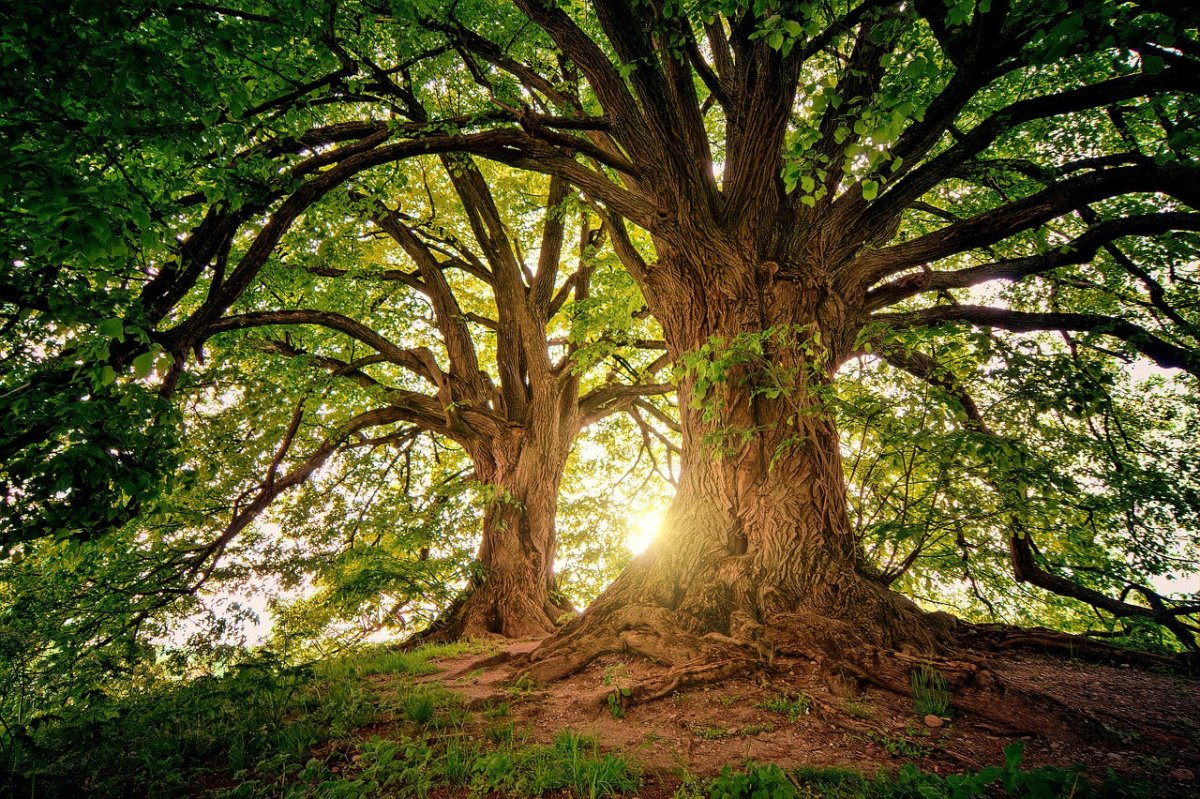
Trees are beautiful – I think we can all agree on that. A tree-lined park landscape or a forest is perceived by most people as an oasis of calm. Simply lying under a green tree and enjoying the sunlight filtering through the leaves – wonderful! While we relax, the tree is at work. Because precisely this sunlight helps it to convert carbon dioxide into oxygen through the process of photosynthesis. So, there are several reasons why we can breathe deeply and relax under a tree.
But trees do even more.
The forests of our Earth are home to more than 80% of the species on our planet – this applies to both flora and fauna. Many of them we have not yet fully discovered or have only partially explored. In addition to their function as oxygen factories and biodiversity guarantors, forests help to bind soil. Especially in mountainous regions, trees ensure that landslides are less frequent. And a forested area can retain more water. Where forests disappear, the first step towards desertification is taken.
So, it's time to remember what trees do for us.
1. Biodiversity
There are approximately 60,000 tree species. It's true! Unfortunately, several hundred species are endangered. This affects not only "wild" trees but also, for example, old fruit tree varieties that are less and less desired and maintained due to a lack of "productivity."
2. From tiny to giant
Japanese garden art is dedicated to the artificial dwarfing of trees. Bonsai is the technique where, through root pruning and wiring of branches, perfectly normal, mature trees reach a height of perhaps 30 or 40 centimeters. And these can be centuries-old pines or sycamores!
In contrast, the sequoias of California can reach a height of over a hundred meters. The tallest sequoia, in Redwood National Park in California, is 115 meters high. Germany's tallest tree, a Douglas fir, still reaches 66 meters.
3. Thick stuff
Trees can become extremely large in circumference. Swamp cypresses, mangroves, and African baobabs are at the forefront here. A swamp cypress holds the record with a circumference of 46 meters!
4. Old as a tree…
...is what the Puhdys (a German rock band) wanted to be. However, they should have been a bit more precise. Not all trees get very old. The colourful flamboyant trees of Madagascar grow very fast, but are often already rotten by the age of 25-40 years. Slow-growing trees, on the other hand, can reach a great age. Unfortunately, how old a tree actually is can only be determined after it has been felled. The tree rings, the pattern of the cut trunk, allow for counting the years of life: one ring is added per year. The texture and thickness of the rings are also informative – they reveal whether a tree has experienced good or rather lean years.
Trees that become very old include olive trees, for example. Some of the old trees in the Garden of Gethsemane near Jerusalem may indeed have stood there as small saplings in the time of Jesus. The record is probably held by a Swedish spruce that has been re-sprouting from the same root for more than 9,000 (!) years.
5. Trees are sociable!
It is only in recent years that it has been accepted that plants are living beings. They develop and "move," albeit so slowly that some things only become visible in time-lapse. As science now knows, trees communicate with each other. They exchange information and even engage in something like brood care. This is made possible by a network of fungi in the forest floor, known as mycorrhizae. These fungi are primarily dependent on trees, as trees supply the fungi with a sugar solution produced during photosynthesis. And surprisingly, the fungi pass this sugar solution on to young saplings that are closely related to the "mother tree." This ensures that these young trees can thrive despite low light in the shade of the mother plant!
6. Trees have perception
How far the communication abilities of trees actually extend – research is still at the beginning. The fact is: trees perceive environmental parameters and take them into account in their development. If you will, trees are able to solve problems (other plants too, by the way). Especially thanks to the perception of the sensitive root tips, the tree "decides" its direction of growth and avoids, for example, overly salty soils.
7. Extensive: the Euro-Asian coniferous forest
By the way – even if the forest is retreating in many parts of the world and needs and receives active support from our tree planters, you could still walk almost uninterrupted through the forest from the west coast of Norway to Alaska!
Preserve trees, protect forests
So, plants and trees are not just decorative perches for birds. Although research in this area is still in its infancy, it quickly becomes clear that we are dealing with co-inhabitants of our planet. They give us a lot. We should show a little gratitude.
At NIKIN, we plant one tree for every product sold – at over 10 locations worldwide. Of course, not the same species are planted everywhere, but locally appropriate ones selected by experts.


