


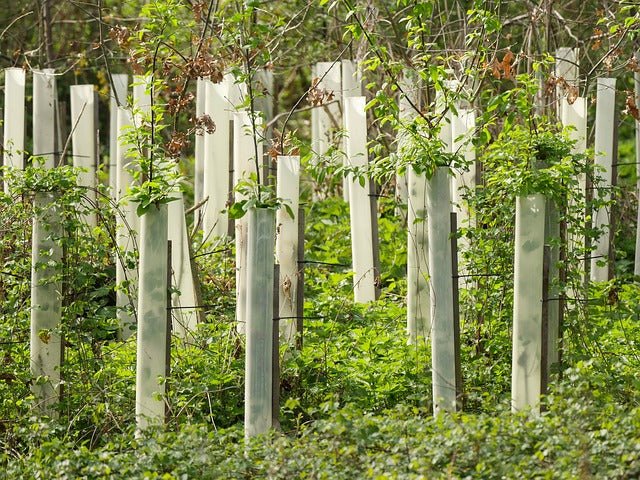
The world's forests are in danger. Every year, an area the size of Costa Rica is lost. We are actively committed to reforestation because it is urgently needed. Why, and how do we do it right?
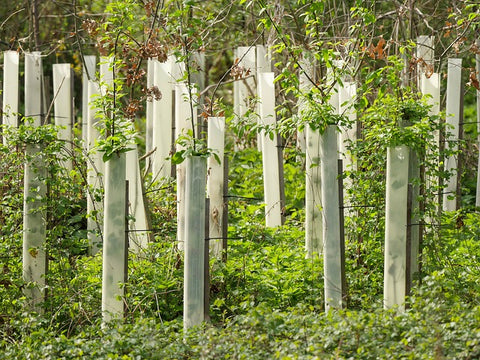
Forests – complex, diverse ecosystems and resources
Trees and forests are vital for the survival of more than just humans. Forests are complex, in some cases unique ecosystems that provide a home for numerous plants and animals, as well as humans. Many species that live in rainforests, for example, are unknown or have not yet been researched.
Among them may be plants that will be crucial for the medicine and pharmaceuticals of tomorrow! If they still exist tomorrow...
The world's great forests extend across South America, equatorial Africa, and Southeast Asia, but also across the Northern Hemisphere, where the boreal coniferous forest stretches from Norway to Kamchatka. Germany, Austria, and Switzerland also still have extensive forest areas. However, much of this is forest, i.e., a "field" of trees. There are hardly any true primeval forests left in Europe. The Bialowieska Forest on the Polish-Russian border may be the last true primeval forest in Europe, and it, too, is under siege.
The good news, however, is that something can be done.
Reforestation makes sense. And it's already happening!
Reforestation refers to the replacement of lost trees and forest areas with new plantings. However, for reforestation to be effective, it makes little sense to plant a series of identical trees in rows, as is the case in traditional forestry.
Instead, a diverse habitat must be created. Small and large trees, conifers and deciduous trees, and shrubs together form a mixed forest, which, thanks to its diversity, can also accommodate a wide variety of living creatures.
In addition, mixed planting doesn't unilaterally deplete the soil of nutrients, and the different plants support each other's growth. Gardeners already know that the shade and root systems of larger trees provide protection for smaller plants, and that the flora and fauna of healthy mixed forests depend on each other throughout the life cycle of all their inhabitants.
Anyone who wants to achieve sustainable reforestation must therefore do more than simply plant trees. It requires the right trees in the right place. Sustainable planters and farmers around the world are now demonstrating this on a small scale, challenging the large-scale, forest-eating monocultures with their models.
We at NIKIN are participating
To ensure that the world's forests continue to provide us with life and recreation for a long time to come, we are part of the effort to repopulate the planet with new trees. For every item you buy from NIKIN, we plant a tree. Not ourselves, of course—we cooperate with our partner OneTreePlanted for this. This organization is committed to planting new trees worldwide where forests are retreating.


